Birgit Jensen, Kong Changan, Animal Form, in: Flash Art, Nr.170, May/june 1993, S.//pp. 72-74
Birgit Jensen and Kong Changan
»ANIMAL FORM«
INTERVIEW
Kong Changan: What made you paint animals?
Karin Kneffel: I started to paint horses fifteen years ago when I got a scholarship for the Cit& Paris. I always wanted to paint something realistic. You can paint land- scapes, people, but I think that animals are the best subject for me. So much psychology is involved when one paints people and I don’t want to touch that field. Although we know these kinds of animals very well, at the same time they are foreign to us. Sometimes you can laugh at them; they are different from us and yet close to us. It can be a bit ironic but not too much, everything is inside.
KC: Do you mean that you have transformed human characteristics into portraits of animals?
KK: It is not my intention, because then the painting would become a caricature, but it does happen. It should be very objective and serious, but never ironic. Also the way I paint should be like that. They seem ironic, but I want to make them look serious.
KC: Your paintings with animals in the past were huge in size. When did you begin to make the “portrait” series?
KK: Two years ago. I have made two hundred of them. The big paintings allow the spectator to come in; the small paint- ings are seen more as objects. But I can not find the relationship between middle- size and the spectator. Most of my gallerists tell me to please make middlesized pictures, but I just can’t do it.
Birgit Jensen: You sell a lot of pictures.
KK: Yes, especially a lot of the small ones as well as the watercolors.
BJ: Do you think the reason is that the object in your painting is quite neutral?
KK: No. When I started this way of painting, a lot of people said that it was not modern art. They liked the pictures, but they didn’t feel allowed to like them. They were always a bit afraid. Even ANIMAL FORM writers. But now it is getting better and better. Some people write about it and the public can say “I like it, and now I am allowed to like it.” The last three years have been very good for me. But before, nobody wanted my pictures.
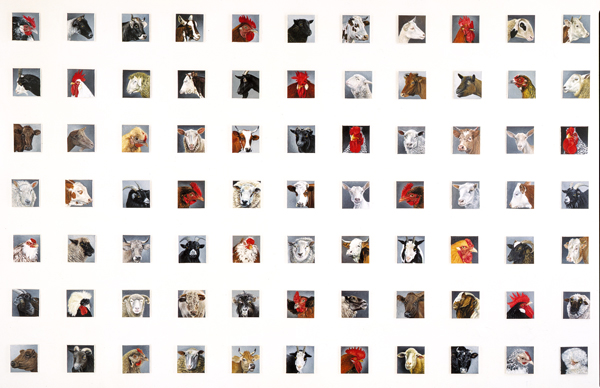
KC: When you put the small ones together in a certain arrangement on the wall, they look like one whole piece. Do you consider this arrangement as an installation or as individual paintings hung together?
KK: Each small painting is still a painting. They are not parts of the whole, they are also individual pictures. But at the same time they form a big installation.
BJ: So they are actually exchangeable, you can change the order of the animal arrangement?
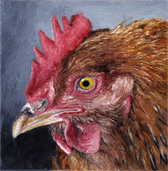
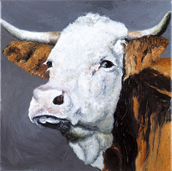
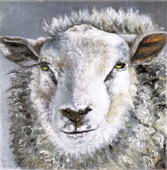
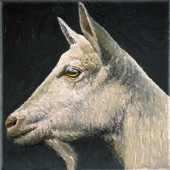
KK: Not really. I always have this arrangement: hen, cow, sheep, and goat.
BJ: Why do you always use these animals?
KK: These animals are domesticated, they are animals which people know, but in a way people do not know them. I do not come from the countryside. I come from Recklinghausen, where there are only chimneys, no cows, no hens, etc. When I am asked to paint some exotic animals, I refuse to do it, except one kangaroo I painted in Australia when I was there.
BJ: Are you trying to avoid any literary meaning by using such harmless models?
KK: That has to do with painting. If there are objects in the painting and one can recognize them, they still are not reality. There is always a sort of truth in painting. Animals have already been painted so often, and one can still paint them, if one finds a way to do it. That challenges me, I am interested in the whole tradition. Surely there is also psychology involved. There is also kitsch, irony, psychology, everything in it. I don’t intend to show that, but it still enters through the backdoor. For me, it only works in a very neutral way. Also the way of painting should be neutral; I don’t mean simple, Just neutral.
BJ: To choose these animals is not neutral. It is a conscious choice. For example there are no dogs and cats.
KK: Oh cats! I hate cats. In very few occasions when I paint dogs I paint them with muzzles. There must be a little bit of feeling for the things I paint. So I can’t paint cats.
 1989_200x250cm
KC: Do you have a moral criterion for your choice of animals?
KK: Animals are often used in fables. I have thought about it, but this is only a minor aspect. The animals I use are neutral: they must be neither good nor bad. Morality is excluded. I never want anyone to say, “Oh these poor animals!” I don’t mean that.
BJ: Do your fire themes also convey a moral message?
KK: I have been trying to paint fire for the past ten years. It is so difficult that I can hardly do it. Because, actually, fire has nothing to do with painting. Fire is movement. But as a subject, it is just so fascinating. Fire burns everywhere around you, the Gulf fire for instance. The subject is just challenging. Also this subject in my painting is neutral in my paintings. When you see fire burning, you don’t know who made this fire, or if it is good fire or bad, you only see it. With fire themes I don’t want to give a hint as to whether this fire is nice or bad.
KC: Your colors have changed completeIy. The old pictures have traditional colors while new ones recall the color of photographs or of hyperrealist paintings. Why and when did you start this?
KK: For the past two years I have been making it a bit different. The reference to photography makes the pictures look more from our time. My work has nothing to do with hyperrealism. Hyperrealist paintings are depersonalized to me, they are a bit too extreme. I prefer somewhere between the new and the old. So I maintain the photo color but also the old paintbrush work. I would like the paintings to be individual and handcrafted.
BJ: You studied with Gerhard Richter, is he an artistic reference to you?
KK: Not really. I always worked very differently. To use animals in this way has to do with painting. For Richter the concept is very important. The object he uses refers to his concept. In my work there is also a concept, but the distance from the painted object in my painting is not as great as in his work.
BJ: Your animal paintings seem very close to photography. What is your relationship to the readymade and to ap- propriation in general?
KK: I use photographs but not rigidly, I don’t copy them exactly. When I am walking around I take pictures of cows and other animals. But not in the way others do it, such as Andreas Schön. I also took pictures of hens and I used the same poses in several paintings. If I want to make them black and white I change them with black and white color. I don’t use a photo as a readymade. Also the sizes of the small paintings refer to photographs.
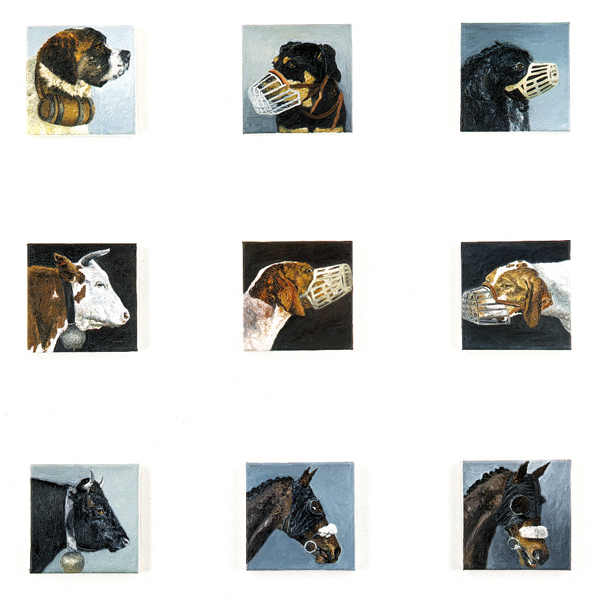 1991_each_20x20cm
BJ: Sometimes your pictures look very loosely painted, sometimes more fixed.
KK: I am getting more and more precise in my painting. I am doing it the other way round than most people who are getting more and more abstract.
BJ: Your animals are very individual.
KK: Yes, but how long can it go on? I hope that time will change things and that all animals will look like my animals. Maybe there will come a day when there are no animals left.
Birgit Jensen is an artist based in Düsseldorf. Kong Changan is an artist and critic based in Düsseldorf and Los Angeles
Animal Form, in: Flash Art, Nr.170, May/june 1993, S.//pp. 72-74