Brigitte Reinhardt
in: Karin Kneffel. Verführung und Distanz // Seduction and Distance, Ausst.-Kat. // exhib. cat. Ulmer Museum; Sinclair-Haus, Altana Kulturforum Bad Homburg; Mönche - Haus Museum für moderne Kunst Goslar 2006,
S.//pp. 28–30,
Verlag Wienand, Köln, ISBN 3-87909-883-2
(wiederabgedruckt // reprinted) in: Karin Kneffel, Ausst.-Kat. // exhib. cat. Galerie Ludorff 2010/11, S. //pp. 2
DARING THE BEAUTIFUL | ON KARIN KNEFFEL'S INTERIORS
Karin Kneffel's paintings are both fascinating and perplexing. How does this relatively young artist create such opulent and realistic paintings, with great precision and technical skill, that are beautiful - in their motifs evocative of wellbeing and Luxury, in their differentiated use of color and in their often oversized formats - and yet still keep those who view them at a great distance?
Karin Kneffel originally became known for her »portraitst of animals in stalls and for her monumental depictions of fruit.
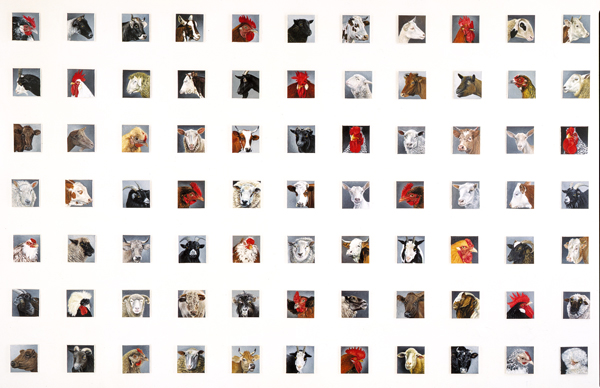
In the early 1990s she painted the heads of cows, sheep, chickens, goats, etc. true to nature, either full face or in profile. Like ancestral portraits, the animals fix their gaze upon the viewer from uniformly gray backgrounds. The impression of individuality and intimacy is, however, dispelled by Kneffel’s arranging these small format paintings in series. Within a strict geometric grid, and with a slight grin, the artist presents a sort of cosmos of farmyard animals. The coolness of the presentation allows us to forget that city dwellers now tend to view them nostalgically.
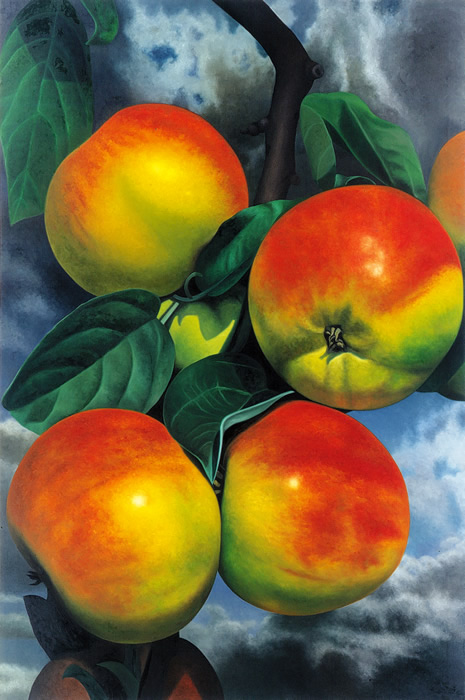
Still Lifes with fruit, not high on a traditional scale of artistic genres, have been being reinterpreted by the artist for the last ten years now, and thereby raised in status. By presenting grapes, peaches and other fruit in extremely close-up views and in oversized formats, their presence becomes monumental, and they seem more consequential. Kneffel depicts the beauty of their flawless ripeness with breathtaking realism. The precision with which she commands her brushstroke - reminiscent of the Old Masters - creates the finest nuances of light and shadow. The artificial, and yet sensual, polish of her paintings both seduces us and keeps us at bay. In this respect there is a certain kinship to high-gloss advertising photos. This concentration on the unblemished and, hence, intact form can also be equated with abstraction. Her exacting execution and adherence to her own rules make motifs that are actually only »beautiful: in a banal sense into effective works of art.
Kneffel’s new paintings have denser layers. They confront us with interiors that are perplexingly alluring. Here, again, a view from close up seems to draw one into a scene that, although cut off on all sides by the edge at the painting, seems to go on forever. The foreground is occupied by what appears to be costly carpets with floral decors. Just beyond the tranquility of their ornamental patterns, is a smooth, shiny floor, in which tiny glints and longer shafts of Light are reflected, and pieces of furniture are indicated in minimal segments depicting legs or casters. These reflections open the painting up to a new space that is new for Kneffel, one that is not precisely defined and which conveys the impression of vibrating movement in the streaky coexistence of Light and dark. The only Living creatures in these segmental interiors are Lone dogs or exotic wild animals. The dogs are seen either running or at rest, while the leopards and zebra Lie stretched out on the floor Like decorative hunting trophies. Their glass eyes stare at the viewer, making these animals of prey, with their jaws wide open, seem almost as if they were alive. The ornamental pattern continues in the attractive markings on the bodies and skins. The individual elements seem to form islands of tranquility within a space that seems subject to dispersion and thereby bring the image back within the surface.
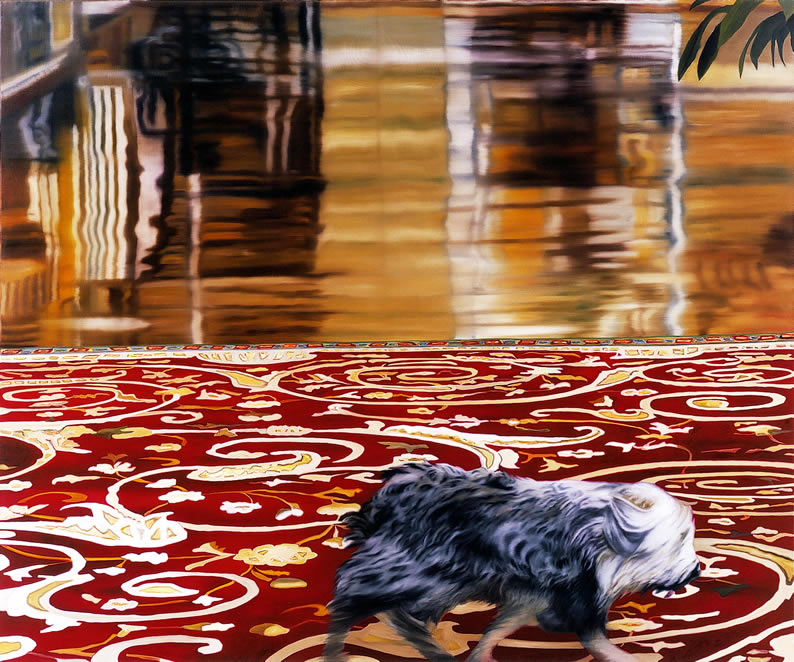
Karin Kneffel needs only a very few props to charac- terize relatively lavish surroundings that may appear to be con- servatively formal or fashionably exclusive. It is not without a note of irony that the animals remind us of something like a safari in which hunting is just a pastime and, hence, of bygone colonial splendor. Again the painter depicts details with tremendous care and wondrous technical ability. However, what she does depict can, and should, remain somewhat ambiguous. Stories are implied which can be sensed atmospherically, although they cannot be defined precisely.
Subjects Like the flowered carpet or skinned leopard baring its teeth can then be found in various constellations. The running dog already appeared in a series of interiors created earlier. These paintings were dominated by geometric tile patterns that filled the entire frame, the elegant spots on the animal's body served as a contrast. The trophy leopard fixes its gaze upon the viewer, even as it Lies on the gleaming floor of an austerely furnished bedroom-office. In this very small segment of the room, a bright picture on a television screen - a girlish hunter with a rifle - corresponds with the wild animal in the lower corner. In between them, a small, live dog is standing quietly.
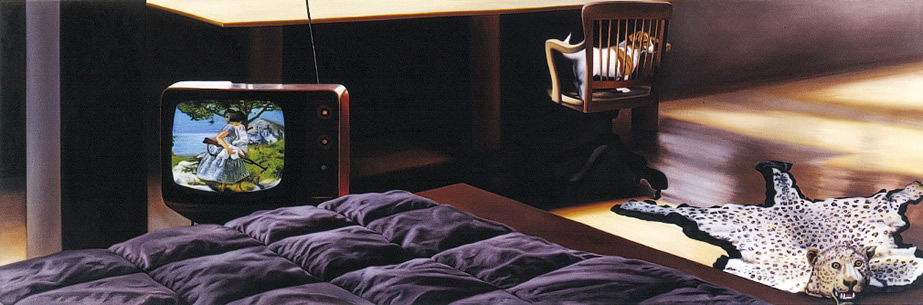
Individual parts of the composition can be recognized as »alternate elements: or as topoi, which she has discovered and photographed in highly diverse locations and which have inspired Kneffel both aesthetically and intellectually. The artist is not interested in preserving real situations. She uses her visual »stockpile« in order to realize her own ideas, restricting herself in each case to a very few motifs.
In her most recent compositions Kneffel has turned away from the objective magic of quieter things and, hence, also from surfaces and ornament. The interiors now open up completely to an increasingly blurry space. They convey its reality, and there- fore the real world, only as a diffuse reflection. In the intriguing interplay of different realities, elements from classical architecture and dogs scampering across the floors suddenly emerge, although in the end their real bodies have already raced out of the picture.
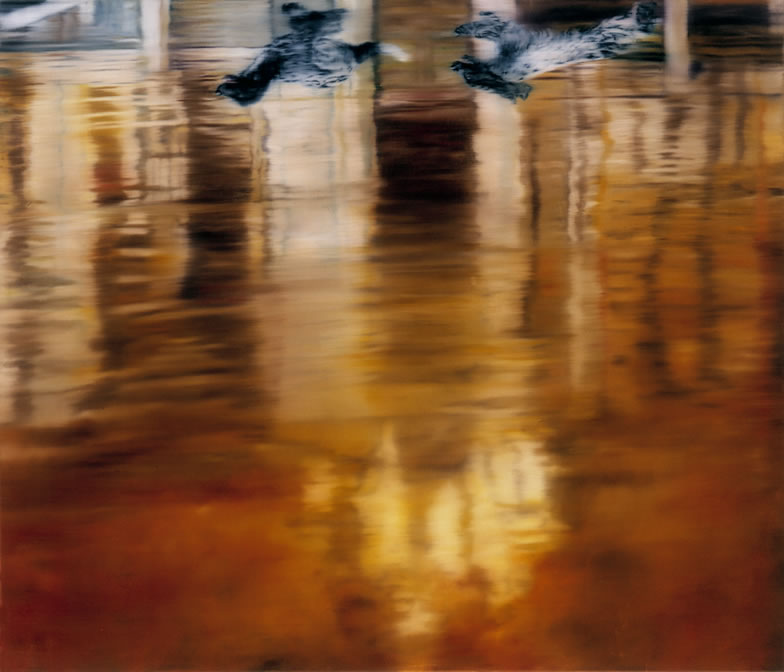
Kneffel's paintings ultimately have a meaning only in themselves, they follow their own rules as works of art that transcend depiction. The interiors can also be seen as abstract, geometrically patterned surfaces or as horizontal color fields. Their ostensible spatiality diverges from the classical perspective: the ornamental tiles, carpets or skins are shown in closer focus than the remaining elements in the painting.
Hence, it is only Logical that none of the works are given titles. The viewer's memories, his own imagination, desires and dreams are activated by this fictive reality and the interplay between alternating levels of perception.
Just as nearly 25 years ago a »Hunger nach Bildern« [Hunger for Images] was addressed in public, paving the way for the triumph of heftige Malerei, a kind new German Expressionism, now a number of contemporary exhibitions are examining the traditional concept of »beauty«.1 The postwar consensus that, as Theodor Adorno claimed, »after Auschwitz no more poems can be written« has obviously lost its validity.
»While decoration and ornament were stripped away by a modernist tradition seeking simplicity and purity, and dragged off like rubble by a glacier, now it seems that people are beginn- ing to take recourse to this original source of sustenance as the narrow aesthetic constraints of modernism begin to melt away.«2
A younger generation of artists is now redefining this controversial aesthetic value, disparaged throughout most of the modern period, and now recognizes )beautyt with ironic double-entendre as a means of artistic expression.
»Composition is the art of organizing the various elements at the disposal of the painter in a decorative manner in order to express his feelings« wrote Henri Matisse, the painter of »Luxe, calme et volupte«. As the »master of the »bonne peinturet and bourgeois decoration« he enjoyed far less recognition than his contemporaries Paul Cezanne and Pablo Picasso. Yet it is, perhaps, not just a matter of coincidence that his work is now being reassessed.3
Karin Kneffel could be found daring the beautiful very early on, i.e. in depicting vibrant animals, fruit in the splendor of its full ripeness, the sensually engaging geometric or floral ornaments, created by nature or by human imaginagion. Her paintings trigger associations with a more refined life style.
»The essence of decoration is in its mediation between two poles, attracting the viewer's attention, catering to his taste, and yet turning him away to face the larger context of life, of which it is an accompaniment.«4
The effect of depicting the image of a rather daringly chosen segment of an interior and filling much of the space with ornamentation, something the public rejected as incomprehensible when it was introduced by the Impressionists, is something we have long become used to. However, the creativity with which Karin Kneffel employs these compositional tools, and the way she succeeds in forming them into a new and penetrating visual language, is remarkable. She subjects the ?beautiful: to a strict system of order, one that is artificial and typifies, and charges things with magic, both overwhelming the viewer and creating a sense of distance, while ultimately serving the work of art.
Brigitte Reinhardt
1 Schönheit der Malerei, Ausst.-Kat. Städtische Galerie Delmenhorst 2005; siehe auch: Ausst.-Kat. pro figura. Luxus, Stille, Lust, Bautzener Kunstverein 2004, Bautzen 2004; Merali Shaheen (Hg.), Über Schönheit, Ausst.-Kat. Haus der Kulturen der Welt Berlin 2005, Berlin 2005.
2 Thomas Wagner, Henris Zaubertafel, in: FAZ 29.10.2005
3 Henri Matisse, Notizen eines Malers, 1908, zit. nach: Maria Müller, Das dekorative Bild, in: Henri Matisse. Figur-Farbe-Raum, Ausst.-Kat. K20 Kunstsammlung Nordrhein-Westfalen Düsseldorf 2005, Ost- fildern-Ruit 2005, S. 218.
4 Hans Georg Gadamer, Wahrheit und Methode, Tübingen 1960, S. 137, zit. nach: Gottfried Boehm, Aus- druck und Dekoration, in: Henri Matisse, wie Anm. 3, 5. 286. Ill English Version quoted from: Hans Georg Gadamer, Truth and Method, 2rd rev. ed., New York 1989 Corig. 1960), p. 158.