Eefke Kleimann
Almost Liquit
on occasion of the exhibition Karin Kneffel
STILL
Kunsthalle Bremen, Museum Frieder Burda, Baden-Baden
Eefke Kleimann, »Fast flüssig//Almost Liquid«, in:Still, Ausst.-Kat.//exhib. cat. hrsg. von // ed. by Kunsthalle Bremen, Museum Frieder Burda, Schirmer und Mosel, S.//pp. 156–165, 2019, ISBN: 978-3-8296-0873-2

Its perfect shell form shines in the light. The staging on the pentagonal tiles lends it a sacrosanct quality. So far no one has yet dared to try a spoonful of this chocolate pudding. This life-size painting of a brown pudding (p. 156, 2003, 67 x 67 in) in so-called “Dekoramik”-form seems like a symbol for the West German post-war period and the rigid social conventions of the 1950s and 1960s, in which Karin Kneffel grew up in the Westphalian town of Marl. Put off by a societal model in which the life questions of a woman were supposed to be “What do I wear and what do I cook for my husband,”
The life questions proposed for a woman derive from an advertising clip (Wenn mans eilig hat [When you’re in a hurry], 1954) from the producer of baking goods Dr. Oetker. The company has posted the video on the Internet under the following link:
https://www.youtube.com/watch?v=pRHb4k9p7Ek
the young Karin Kneffel occasionally dropped her first name and choose to be called “Axel.” Like many of her contemporaries, she quarreled with the normative role models of the period.
Information on Karin Kneffel’s biography and her personal perspectives on work
were taken from an interview with her, as well as from different publicly conducted conversations
Some of her works touch upon her childhood and youth in the late 1950s to 1970s. Among these are depictions rich in the spirit of the era such as, among others, the aforementioned pudding in shell-form, ornament-rich interiors, cathode-ray tube televisions and stuffed animals (pp. 14–15/18/22–23) – the simple multi-family houses of the 1950s, like those familiar from the Ruhr region and those in which the artist herself grew up (pp. 170–173). Nevertheless, her paintings come across as neither nostalgic, nor arrested in space and time in a clear-cut way. For temporal and pictorial levels liquefy into each other: time markers like architecture and interior furnishings, pictorial citations of old films, timeless motifs, snapshots of states, processes and points of view, riddling perspectives, irritating reflections. “Her time” understood as restricted to the period of her youth, however, does not exist for Karin Kneffel. Her time is always; she carries her memories, paintings, impressions with her and she makes fresh use of them time and again for the next works.
That said, her youth was formative in regard to the evolution of her artistic talent. As a left-hander, she went through the then conventional, albeit discriminating forced reversal of handedness. However, her art teacher realized that her left hand was not a deficit, but rather could be the instrument of a special talent. When she later earned extra income as a model in a drawing course during her humanities studies in Munster, she picked up the pencil herself, became aware of her passion and transferred to the Academy. In Dusseldorf she then studied with Johannes Brus, Norbert Tadeuzs, and Gerhard Richter and was ultimately a master student with Richter. Later she revisited Richter’s work aesthetically and devoted two work groups to his famous Kerze [Candle] (1982) (pp. 60–65) and his iconic painting Betty (1982) (pp. 52–58).
The confrontation with the portrait
One early work group that the artist developed following her studies consists of 300 small-format animal portraits (pp. 10–11). Each one measures only 7,87 x 7,87 in and hence stands in contrast to Kneffel’s monumental depictions of fruits or fires, which can be over 279,53 inches wide and which were created only a few years later. With the depiction of animals such as sheep, goats, pigs, chickens or cows, she already confronted at the beginning of her career a central genre of painting – the portrait. In doing so, she conceived each animal as equal in size, irrespective of the fact that their dimensions in reality are quite different. Now in profile, now head-on, always in front of a monochrome background, she painted the heads of working animals, to which she felt a certain closeness due to domestication, yet also distance as a city-dweller. For an exhibition, she arranges a selection of the small formats, always anew in relation to the given space. She reassembles them like a mosaic and follows her own algorithm that dictates in what order the animals appear.
With this series, Kneffel not only researched the appearance and behavior of the animals that she portrayed, but also worked through the pictorial genre of the portrait, which she otherwise refuses in relation to the representation of people in her painted work. She finds them too psychological and too close for her own pieces and always works with effects of estrangement, veiling, and distanciation when human figures do appear in her work. Even a painting of the actress Doris Day from 2016 (p. 28) is not a classical portrait. W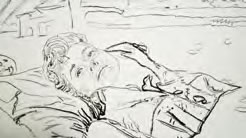 e see her in her role as Jo McKenna in Alfred Hitchcock’s film The Man Who Knew Too Much from 1956. The painting seems like a film still in which Doris Day – bedded on a blue
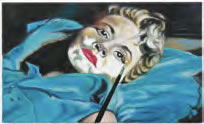 pillow – is looking up yearningly. At first glance, one might almost believe that the painting is not finished. Crude white surfaces on cheeks and chin are surrounded by isolated applications of paint. In addition, the blouse and pillow are not differentiated from each other in terms of material or colour. In fact, a fine, black paintbrush, looming into the middle of the picture, is just in the process of touching the eye of the subject. We thus see the painted picture of a film image, which is about to be painted. The painter paints her own painting. She shows us what she is seeing while she creates this painting. All at once as spectators we mutate due to our perspective into the painters of this picture, who are ourselves holding the paintbrush. Rather than a portrait of Doris Day, this work is a reflection on the creation of images through their producers and recipients. In the process, such clear role assignments liquefy into each other. Karin Kneffel does not allow us to lose ourselves in the longing gaze of the figure; she also encourages us to put into question the status of the picture and our own hasty conclusions.
The unfamiliar back-then
Those familiar with Kneffel will have the impression of having seen the picture once already, and not only due to the popularity of the person represented. While the painting of the film still is depicted here as in the process of being painted, Kneffel actually already worked on the same sequence three years earlier. Here the complicated media transfer from film to painting does not play a significant role; nevertheless, questions regarding the image medium of the apparent Doris Day portrait do remain relevant. In 2013, the artist created a whole cycle of façade views of simple, brightly plastered three-story postwar multi-family houses with saddle roofs. She repeatedly varies the views, colour moods, and light effects and in doing so creates a suspenseful, chargedgloomy atmosphere. Having grown up herself in such a building, Kneffel had the formative idea from her childhood years that all houses looked the same and hence also that the living spaces must be filled with an identical lifestyle. The view out the window in effect delivered the mirror image of one’s own everyday life. So we viewers are looking as though out of a window at a bouquet of tulips and their reflection, as well as at the mirroring of the Hitchcock TV image, and then past these to a house decorated with ornamental plays of shadow (p. 173).
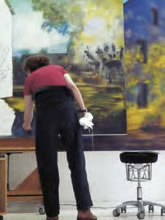
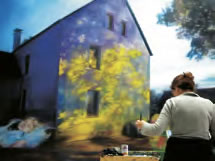
In other paintings of this work group, sequences from Hitchcock’s legendary cameo appearances and thus his self-questioning as an artist are also cited. Especially pithy: the apparent hand print (p. 172) of his left and right hands. Kneffel derived this pictorial element from a making-of photo (p. 173) in which the director stands with raised hands in front of the lead actress of the film Torn Curtain (1966), Julie Andrews. Yet the print does not appear to be an element of a reflected TV image in the window; rather, it looks as though the hands had been laid directly on the painted pane. In fact, it is not a real handprint on the canvas, but the painted image of a print. Kneffel herself tested the effect in her studio with her own hands and a glass pane, photographed the outcome, and then copied the print meticulously (p. 65).
When she re-integrated this pictorial element in the same year into a completely different scene, she was citing herself, but also the documentary photography from the shooting of Hitchcock’s Torn Curtain (pp. 177/179–181). Kneffel unsettles us as viewers with the repeated integration of identical or similar objects in the most varied works: have we not already seen this picture once, and from what context do we know it? The borders of the individual works become blurred in our perception; differences go out of focus. The aggregate state of the paintings edges into uncertainty – works complete in themselves become variations, facets, differing versions of ideas – they become liquefied and fill a space between.
In the process there is an entire repository of motifs that we find over and over again in the most diverse works, such as tulips (pp. 169/175), the X-shaped cross (pp. 184–185), the cleaning women (pp. 179–181), Persian rugs (pp. 14–15/ 72–73), special dog breeds (pp. 17/26–27), or the curtain in blue, turquoise, and green tones (pp. 25/68–69/182–183).
These moments in the encounter with Karin Kneffel’s work, which one can also describe generally as déjà-vus, were emphasized by the artist in a special way in a site-specific project that she realized in 2009 in the Esters House and Lange House in Krefeld.
Impressed and inspired by an exhibition of the American painter Eric Fischl in the same museum, she took the premises of the Mies van der Rohe buildings as her starting point. Intensive research led to a painterly confrontation with the history of the exhibition space, which was originally the private residence of the collectors Lange and Esters. In doing this, Kneffel examined historical photos (pp. 51/68–83) of the interiors, which were furnished with art and design, among other things; she painted them life-size and hung them on the appropriate walls on the exhibition surfaces established today. Unease, irritation, strange recognition may have been sensations of visitors to this exhibition. On the one hand, they stood in the rooms of the house with its white-cube quality; on the other, like unseen observers, they looked through structures such as water drops and air bubbles into the private interiors of the people who once lived here. Like time travelers, the viewers of the Krefeld show oscillated between the here-and-now and the back-then that is unfamiliar to them. The invisible pane, through which one seems to look at these paintings, allows the historicity of the represented figures to become graspable.
A new version is available
The subheading is a direct citation of a book title by Dirk von Gehlen,
Update. Eine neue Version ist verfü¨gbar [Update. A new version is available],
published in 2013 by Metrolit Press. His publications are central for the understanding of culture as software
The Krefeld project continues to have an effect in Karin Kneffel’s work today. Above all the confrontation with the buildings of Mies van der Rohe has since posed a focal point in her work. For instance, among others, she has intensively dealt with Mies van der Rohe’s Barcelona Pavilion (pp. 198–209), the Seagram Building in New York (pp. 186–197), and the Lehmbruck Museum in Duisburg (pp. 96–103), which was designed by Manfred Lehmbruck, a Mies student, and conveys the influence of the well-known Bauhaus architect.
In regard to the confrontation with the Mies ensemble in Krefeld, the 2009 exhibition must be seen more as a beginning than as a conclusion. In the aftermath, Karin Kneffel ultimately realized that during her artistic research into the interiors, she had disregarded the artworks of Esters and Lange that were depicted on the documentary black-and-white photos. Among which: iconic works by artists such as Ernst Ludwig Kirchner, Oskar Kokoschka, Wilhelm Lehmbruck or Marc Chagall. With a detective’s instinct, persistence and patience, she gradually assigned artists and titles to the artworks shown, researched the present locations, and visited them on multiple occasions in order more and more to draw near to them. Back in the studio, she once again began to paint the Krefeld villas – this time with a special focus on the collections of the former residents, now displaced with ghostly structures, peculiar lightings, liquid-seeming effects and suggestions of cleaning staff personnel (pp. 114–115).
 In parallel, a series of paintings emerged that shows the artworks that she tracked down in their current locations – for example in the Neue Nationalgalerie in Berlin or at the Städel in Frankfurt am Main. In doing so, she tackled the material in such depth that immediately following her tip on the striking discrepancy to the historical installation in Krefeld, the hanging of a painting in the Frankfurt Städel was actually turned 180° (pp. 138–147).
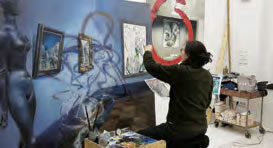
 Meanwhile, Karin Kneffel held fast to the progress of her inquiries in a painterly manner as well. Thus she painted off of a multitude of her research sources – the sometimes out-of-focus, blurred, black-and-white, historical photos – and on the canvas commented them with underlinings, X-crosses, ticks or brackets in red paint (pp. 76/95/113/119/124/128/133/140–141/143). What looks like a broad, impasto-applied brushstroke is actually the painterly copy of such an application of colour. Through the red paint in Karin Kneffel’s paintings – which is applied in fine strokes, with painterly mastery – the momentariness, the processual is almost squeezed out of what is essentially a quick, impulsive, gestural jotting. The currency of a state of knowledge or a project is captured on the canvas. Here, too, the aggregate state is changed. Though from fleeting to manifest.
From fire to water
The testing of the possibilities and exploration of the essence of painting already played an important role in the early years of Karin Kneffel’s artistic creativity as she painted fire of the most varied kinds and intensities in a series of sometimes monumental paintings (pp. 36–37). The menacing dance of the flames unfolds a piercing interplay of alluring attraction and sustained appallingness. How can one capture on a canvas the only difficultly controllable character of flames? As a force of nature, fire carries the destructive within it and is an image for human primal fears, tied to culturally imprinted ideas of cave fire. At the same time, the creation of fire was an important stage for the development of humanity – as a source of light and warmth, it is a giver of life.
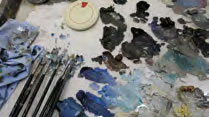 The element of water is similarly complex. Kneffel’s manifold examination of it extends into the present. The paintings of the last ten years are quite literally liquefied; in them, our gaze threatens to swim [verschwimmen, tr. note: also, to “blur”], and traces of water shape our vision on the further pictorial planes. In addition, she works in her studio as in a laboratory and investigates how her images function behind fogged, moist or even wet panes of glass; what reflections become visible in the small pearls of water; h
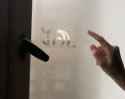 ow it looks when one paints with the finger on a window wet with steam or condensation.
 Sometimes her many-layered wet-on-wet painting requires that she work up to fifteen hours at a stretch. If she cannot find a good stopping point and is worried that a colour seam might appear on the canvas, she lies down on the sofa in her studio for three hours, closes her eyes and then starts painting again before the paint completely dries.
In the process, she also knows that canvases are patient, that paintings sometimes have to be put to the side before they can be completed, but also that an idea sometimes does not hold up or that she is running up against her own painterly limits.
Walls of glass …
The most recent works from the year 2018 are complex compositions, peppered with clues to Karin Kneffel’s decades-long developed repertoire of motifs, which is nevertheless revealed in new raiment here. The series of three horizontal- format paintings shows the view into the Lehmbruck Museum in Duisburg (pp. 96–103).
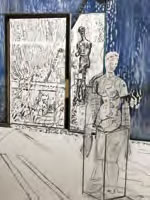
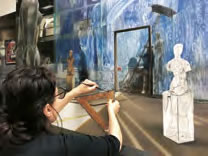
In the middle of the exhibition space, in which modern, figurative sculptures are found, a glass cube stands. Cleaning staff are meanwhile working on it, soaping up the panes, wiping and squeegeeing them off. Unlike in her earlier paintings, in which the figure of the cleaning person was always portrayed by women, this time it is men who are working on the cube with an almost painterly gesture. Here Kneffel is no longer citing the cleaning ladies as found in Hitchcock films, but rather springing into her own present, in which the overhauled range of activities for males and females is occasionally beginning to blur. The sober form of the glass cube, which symbolically stands for the functional ideas of the Bauhaus and the modernist tendencies of Minimal Art, is broken through the representation, reminiscent of gestural abstraction, of water and foam. In a subtle manner, Karin Kneffel cites almost in passing the co- and contra-existence of opposing artistic positions from her predecessor-generations. These are joined by Lehmbruck’s sculptures, which add a figurative element to the tableau. In the large gesture of the window washers, one can read a humorously feminist allusion to the fact that in the period in which the great debates were conducted about “painting after the end of painting,” it was mainly artist men who obtained recognition and fame.
Through the banal, everyday practice of cleaning, the glass, cubic architecture that has become an icon in modernity is also undercut. In her work over the last ten years, Karin Kneffel shows a decided fascination for these legendary buildings, but she does not neglect to lend them a certain groundedness. Sometimes it is sagging tulips or Mies’ cigar still glowing in the ashtray (p. 81), sometimes it is a waiter having a midday nap (pp. 196–197) in front of burgers and soft drinks at the posh Four Seasons restaurant in Mies’ Seagram Building in New York. These clean, glass worlds, which one frequently knows from uninhabited reproductions in glossy magazines and art-historical catalogues, become in Karen Kneffel’s depiction venues for unknown, past or future everyday occurrences.
… in a glass society
A remarkable chain of reference emerges in the process: as though unnoticed, one seems to be looking through windows into rooms, which are characterized architecturally by a particular use of glass. It seems to play no role that there where the view opens for the viewer, there is usually no window in the actually existing building. The pictorial plane of glass that Kneffel slides in, which becomes apparent mainly through reflections and other surface effects, is the means of distancing, the closing off of the viewer, the intermediation between the ambiguous layers of time that lie between what is represented and the period of the viewer. A direct communication between the personnel in Kneffel’s paintings and us as viewers is never possible. Usually a figure turns its back to us, dozes or is deep in work. We viewers are voyeurs, looking unnoticed through the glass walls as though we were simultaneously in the same place and time as the figures, but somehow also at a completely other place in a different time.
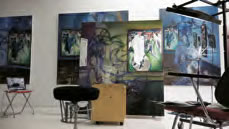 A reception experience has long become everyday in our digitalized society. We have grown accustomed by now, with our smartphones and by dint of social networks, chats and tracking software, of getting profound insights into spaces, relationships and situations
 without being actively involved ourselves. While it is possible to make contact through comments, emojis and hashtags, the proportion of individuals’ consumption of images and data is far greater than that of their own production.
Dirk von Gehlen in Update. Eine neue Version ist verfügbar, Metrolit Verlag, Berlin 2013, p. 80.
Karin Kneffel has made the picture and sign language of the digital her own and comments herself within a painting now and then by means of smileys (pp. 49/71) and pictograms (p. 28). Through this a metalevel arises that was also encountered in other ways in the Doris Day painting. Communication with recipients, as well as the simultaneity of the production and presentation of a work, of a critical confrontation with the painting’s theme and its own representation, become central aspects of the painting. Through the smiley, the painter speaks directly to the observers, while in the process the impersonal-abstract quality of the emoticon veils her presence. Publicists like Dirk von Gehlen speak fittingly here of culture and society’s liquefaction tendencies. Due to changes in communication and mobility we should “think of culture less as a product, than as a process in which not only a robust piece of work by itself, but also its release version plays a role.”
von Gehlen 2013, p. 8
The making-of as new space
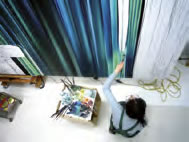
In her two-part catalogue Endlich [Finally] published in 2015, Karin Kneffel extensively lays open her work process and in one of the two volumes publishes a rich-in-images making-of on the works that are depicted in the other volume. Large-format photos of the creative process show canvases with rough charcoal preliminary sketches and initial painted sections. Sometimes the images also appear to be shortly before completion. The artist is frequently turning her back to us in these photos, engrossed in the work. In some shots, a small tube-type TV or a laptop with a running program can be seen standing near her. From time to time she needs this backdrop of noise, the flickering, if she is spending hours-long alone in the studio. She thus has the feeling of counteracting the loneliness of the work.
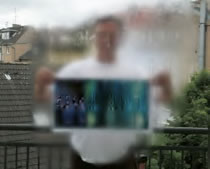
Through the photo documentation, we have a share in how Kneffel tests out individual effects and pictorial planes in the studio and documents them through photography in order then to be able to transfer them onto the canvases. For this, she wends her way with her index finger over the fogged window pane with a line of sight into her garden and writes “Butter never crossed my mind” or “I need a wall behind me” – nearly poetic quotations from Philip Johnson and Mies van der Rohe, which she appropriates in this way for herself. Or she has someone hold up an oil sketch behind a pane and so can study it as the moist glass changes colour effect and image sharpness.
With an impressive openness, the artist grants us glimpses into different versions of her not yet concluded works. Humorous and easygoing, she in the process also deconstructs mystified images of artists, for example, when she lets herself be photographed in the studio with an inflated hood dryer.
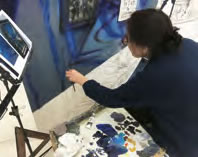
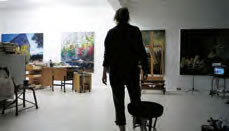 Karin Kneffel is not afraid of our unraveling the secret of her visual worlds or of her being demystified through insights into her creative process. Quite deliberately she allows us as viewers in her publications – not in exhibitions, not through public studio visits – to participate in the stages of creation. This kind of controlled participation has almost become the convention in the art industry in the last ten years. In doing so, dynamic online media are used mainly, such as Instagram, at the moment arguably the most relevant social network for visual artists. Through daily video clips, photo galleries and tags of places and people, artists allow their followers to participate continuously in their activities and encounters. In this, the degree of authenticity and staging can vary with every contribution. In an interview with Dirk von Gehlen, the art historian Wolfgang Ullrich stated concerning this development: “For some years we have had a making-of cult. Here the recipient is conveyed a feeling of witnessing and participation. While I am not there live during the creation process, I am allowed to completely follow it retrospectively. This alone is already felt to be a privilege.”
Wolfgang Ullrich quoted in von Gehlen 2013, p. 92. Translations of quotations are by the translator of the current text.
The opening of the studio and the insights into work processes facilitate a new experiential space in which artist, artistic work and viewer can meet. In the process, the tendency arises to understand a work more as a carrier of different versions; also emerging is a perspective on artistic creativity that focuses on the ephemeral character of painting rather than on its products. Von Gehlen concludes: “Digitalization makes art and culture into software – we should at least think of them as software in order to be able to understand and use the changed conditions in the digital age. We should set the concept of the version against that of the self-contained original piece of work.” von Gehlen 2013, p. 16.
Painted snapshots
Karin Kneffel does not only record these processes in studio documentations. In her paintings, she also preserves moments, stages and insights whose development can then be further observed in a subsequent painting. The work groups that arose through Kneffel’s confrontation with the Esters House and Lange House in Krefeld and evolved over several years can be identified as central examples for these painted snapshots. But also the smiley, which she placed on a Velázquez variation (p. 49) t
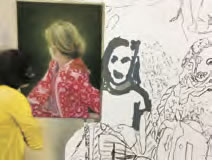 hat she did, appears to fulfill a kind of commentary function that in a sense updates what is depicted, that turns it into the object of a discourse occurring in this moment. In a single painting the painter succeeds in bringing together different moments and evoking the feeling of different temporalities. This also occurs literally in interior scenes in which mirrorings of animals or objects differ in stance or movement from their source (pp. 21/26/27) or when opaque reflections show up on the pictorial surface, which give us the feeling of sitting in a traveling vehicle while we look out through a glass pane. Time comes into the picture – and not as a wild, painterly gesture or even in the form of drippings. It is not abstract traces of a quick impulse that convey to us the feeling of movement, liveliness, momentariness, but rather the figurative pictorial elements and the partly fantastic effects such as alternating reflections, blurredly shining materials or ghostly swaths, applied by the painter with a small brush and in highly concentrated, glaze-like manner. Karin Kneffel thereby suspends natural laws in her representational paintings and liquefies that which is commonly seen as reality or norm – be it in scientific, societal or artistic terms: mirror images are not exact equivalents to their originals; women in dirndls carry weapons (pp. 22–23); and in Mies van der Rohe’s Barcelona Pavilion, Georg Kolbe’s sculpture Der Abend [Evening] is suddenly standing, although in fact his Morgen [Morning] should be seen there (pp. 203–209).
Mash Up
The last example can be described in Dirk von Gehlen’s words as a “mash up”08 Dirk von Gehlen, Mash Up. Lob der Kopie, Suhrkamp, Berlin 2011. or “remix.”von Gehlen 2013, p. 59.
Karin Kneffel appropriates a certain site – the Barcelona Pavilion – and then implants into her painting of the Mies space an existing work by Kolbe different from the one actually found there. 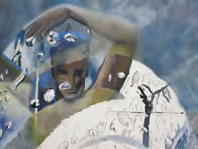 But even within her own oeuvre, she cites, mixes and substitutes – thus in works from the most varied cycles, one repeatedly finds bunches of tulips, special curtains, rugs, film protagonists or pieces cited from art history, which she then connects together in a complex field of tension between déjà-vu, document and fiction.
 The comparative vision of Kneffel’s oeuvre also enables an inference about the work process. The fact that certain elements show up repeatedly, points to a sort of fragmentary picture archive that is fed by Karin Kneffel’s memories, found objects and photos as well as by the repertoire painted over the years. She photographs, sketches or collects appealing things encountered in the everyday and then makes use of these visual templates in order to find impulses for her paintings. Elements are integrated into spaces actually foreign to them and put into new contexts. Although the painter lays claim to representing a site correctly in principle, such as a salon in the Esters House or Lange House, on occasion she also exchanges an ornamental textile for one with a different pattern or sets cleaning women from a Hitchcock film onto the floors of the Krefeld villas although they were never there. These appropriation and remix processes were developed in Karin Kneffel’s work at the same time as the digitalization of our society and the intensifying “reference culture” von Gehlen 2013, p. 59. of the Internet since the 1990s. Networked thinking, tag clouds and cross-references today shape our concept of knowledge generation and organization. Contents can repeatedly be networked anew through different key words and consequently stand in different meaning contexts. This has impacts on our thinking: far more than linear structures, the rhizome here seems to be the appropriate image.11 If one looks at Kneffel’s work groups that emanate from the Esters House and Lange House, the various origin dates cannot be accounted for visually. In terms of reception, the works do not stand in a chronology, but instead span a common network of connections.
Art history – a fairly old remix
The reference by visual artists to predecessors’ or contemporaries’ works has in any case a tradition in art history and is not something attained since digitalization. Exhibitions like Nachbilder. Vom Nutzen und Nachteil des Zitierens für die Kunst [Afterimages: On the Benefit and Disadvantage of Citation for Art] (Kunstverein Hannover 1979), Originale echt falsch [Originals Truly Fake] (Weserburg, Bremen 1996) or Déjà-vu? Die Kunst der Wiederholung von Dü¨rer bis Youtube [Dèjá-vu?: The Art of Repetition from Dürer to Youtube] (Kunsthalle Karlsruhe 2012) proved that “the copying and reproduction of particular models [...] [is] a widely dispersed artistic practice that is as old as art itself.”
Ariane Mensger, “Déjà-vu. Von Kopien und anderen Originalen,” in exhibition catalogue, Mensger (ed.): Déjà-vu? Die Kunst der Wiederholung von Dü¨rer bis Youtube, Kunsthalle Karlsruhe, Kerber Verlag, Bielefeld / Berlin 2012, pp. 30-45, p. 30.
In the last show, curated among others by Wolfgang Ullrich, an arc was made from the Vera Icon to the present, and new media with portals, like Youtube or Flickr, were included. If one tries to develop a history of the artistic return, bridges can be made from book painting to digital art – art histories and works that would otherwise only come in contact with each other with difficulty. Conventional categories start to waver.
Karin Kneffel once said in an interview that she herself is like a sponge that soaks up everything that is around it. It is noteworthy how the artist invokes a metaphor here which describes her own environment as something fluid and hence a vocabulary that is used to understand the consequences of digitalization for society. Looking at paintings such as (p. 75) or (p. 109), one almost has the impression that she has squeezed out [ausdruückt, tr. note: usually understood as “expressed,” but here playing on being literally pressed out] a sponge over her works, doused them with it. To a certain extent they become unrecognizable through these watercourses; they veil; they are not decomposable into their individual parts. We cannot get to the bottom of paintings such as Karin Kneffel’s. Although her oeuvre consists of seemingly self-contained, finished paintings, in our viewing we ourselves will never really be finished with them, come to the end, be able to conclusively grasp them themselves in their many layers.
The painter also smashes one-dimensional, cliché-ridden conceptions of the mythos of the artist and instead offers a plurality of images and possibilities of her personality: At the end of the making-of catalogue, she presents herself in a grid of 30 photos in passport-picture format. Shots from the last 30 years show her now with a strand of hair coiled around the tip of her nose, now photographed by a famous photographer, now almost unrecognizable behind a fogged pane.
An algorithmic computer program provided her the compilation of images through a facial search – and thereby numerous versions of an artist who unswervingly questions, remixes and updates art history and her own painting. In the process, Karin Kneffel mixes the sublime and everyday and refreshes traditional genres and modes of reading. She questions her paintings in order to supplement the next version through a new perspective or discovery. Sometimes her smileys address us directly as viewers; sometimes Kneffel’s works embed us unnoticed into a complex feedback loop. In publications, the artist allows us to partake in the creation of her works and thus opens up a further experiential space. In all this, she emphasizes the processual without aggressively putting into question the concept of the work as such. Even if she sometimes threatens to wash away her own paintings with coursing colours, something always remains stuck to the canvas, preserves us from the leap into the depth of the pictures, throws us as viewers back onto ourselves.
We are not becoming one with Karin Kneffel’s works, but something is moving. Almost liquid.
(Translation by Ehren Fordyce)
Eefke Kleimann, »Fast flüssig//Almost Liquid«, in:Still, Ausst.-Kat.//exhib. cat. hrsg. von // ed. by Kunsthalle Bremen, Museum Frieder Burda, Schirmer und Mosel, S.//pp. 156–165, 2019, ISBN: 978-3-8296-0873-2