Julia Voss
Conversation with Karin Kneffel in her Studio in Dusseldorf
on occasion of the exhibition Karin Kneffel
(Translation by Ehren Fordyce)
STILL
Kunsthalle Bremen, Museum Frieder Burda, Baden-Baden
Julia Voss, »Gespräch mit Karin Kneffel in ihrem Atelier in Düsseldorf//Conversation with Karin Kneffel in her Studio in Duesseldorf«, in:Still, Ausst.-Kat.//exhib. cat. hrsg. von // ed. by Kunsthalle Bremen, Museum Frieder Burda, Schirmer und Mosel, S.//pp. 84–94, 2019, ISBN: 978-3-8296-0873-2
Realism
Julia Voss—How did you come to the idea of painting fruit?
Karin Kneffel—For a start, it annoyed me that at the time at the Academy in Dusseldorf the saying went that one must not paint this or that. Fruits or even animals, for example. They belonged to the things which were suddenly held to be unpaintable.
Julia Voss—Why?
Karin Kneffel—Too decorative, hence even more unsuitable for a woman. Or it was said, fruits have been painted so often after all. Too often. In this way topics were simply checked off or turned into fighting words. These bans never made sense to me; rather they awakened my interest. Besides, fruits seemed suitable to me for accentuating the special features of a painted representation as opposed to reality. How does a painting show itself to be a painting? Questions about reality and realism occupied me. What about beauty?
Julia Voss—Do the Old Masters and their still lives play a role for you in this?
Karin Kneffel—Certainly. As a painter you do indeed look upon a long tradition; art history with all its many, already painted still lives “pop” up before your inner eye. But then you mustn’t forget the format. Here we’re by Pop Art. Julia Voss—Your paintings are frequently very large. The peaches from the year 1996 are in a vertical format; they measure more than seven meters. What attracts you to large formats so often?
Karin Kneffel—I have also done many quite small paintings — the animal portraits, for instance.
Julia Voss—From the early 90s, that’s true. Then I’ll formulate the question differently. What is better with very small or very large paintings?
Karin Kneffel—I have always had problems with the medium format; for me, that is the most difficult size. A very small painting is almost like an object. That has to do with the way one focusses. It is a much more compact seeing. A large painting is more of a vis-à-vis, a piece of space. But medium formats have no proper distance. If you’re leafing through a book, then you know it’s a book. But with a medium size? You do not know where you’re at. It does not occur to me what I could paint on it. A corner of a room maybe. But a whole landscape in a medium format? I am always happy if it works out for me nonetheless.
Julia Voss—What role does realism play for you? In your paintings there is an almost photographic accuracy, for example, the drops that come up in your series on the Lange and Esters Houses, which Mies van der Rohe built in Krefeld.
Karin Kneffel—The drops are the opposite of realism. They transform the picture, they make it artificial, and a plane of the imaginary emerges. Yes, it’s just the apparent view through a window. But we don’t see that way. In reality if you see drops on a pane, you see them in focus. What’s behind becomes blurred. But if you observe the space behind, then the drops disappear from your field of vision. This focused gaze is turned off in my paintings; everything occurs on one plane and you see both simultaneously. Additionally, the drops are unreal due to their size. The surroundings are reflected back in them; one sees houses in them, for example.
Julia Voss—That’s right! Houses with pitched roofs, tiny! So where are they from?
Karin Kneffel—Those are the houses opposite, on the other side of the street from the Esters House and Lange House in Krefeld. At the end of the 1920s, there were pitched roofs everywhere. However, the Bauhaus architects preferred the flat roof – Mies van der Rohe, too. In this way I let the neighborhood come in, mirrored.
Julia Voss—The liquid also has something mercury-like about it.
Karin Kneffel—Yes, that’s right, but also of the aquarium. As though one were oneself floating in a liquid and exhaling, so that little bubbles rise up. Together with the panes, the drops establish distance – between the observer and the pictorial space. I want observers to look at the paintings and reflect on them. They should not get lost in them. In addition, the voyeuristic moment in this pleases me. When there is a pane through which one looks, one has the feeling of doing something forbidden. One encroaches onto a private sphere.
Julia Voss—So realism is also not important for you?
Karin Kneffel—Let’s put it this way: I want it to be plausible. I once had the case where I painted a reflection, a flickering television image, which shows up on a pane. The same television appeared again in the painted house in the background. While painting, I noticed that it could not actually be that way. The reflection in the pane had to be reversed, in contrast to the image. So I scraped off the paint once more and painted everything over again. The pictorial reality has to be consistent. But it is not therefore realistic.
Models
Julia Voss—There is a painting of yours from the year 2011; it shows an interior in black and white, which has been crossed out with red paint. Can you understand that this makes me think of Gerhard Richter?
Karin Kneffel—Naturally, the picture has something of that. I also had to think immediately of Richter’s painted brushstroke. A painter colleague said to me, completely euphoric: Ha, that is a programmatic painting, with that you’re crossing out Richter!
Julia Voss—One could think that.
Karin Kneffel—Yes, but ironically, not seriously. I had to laugh while painting. He painted this big brushstroke; he painted based on photos. And I cross out a photo. But the starting point is a poster from the Bauhaus period.
Julia Voss—What sort of poster?
Karin Kneffel—In 1927 there was an exhibition called “Die Wohnung” [“The Living Space”]. Willi Baumeister designed the poster for it. “Wie wohnen?” [“How to live?”] was printed on it; the old manner of living was crossed out in the picture with two red, crossed bars. A bourgeois style of furnishing was shown. This is what I’m referring to. In the Esters House and Lange House there was actually this kind of furnishing, which also could not have pleased Mies van der Rohe. He was certainly not happy about it, that this pre-existing bourgeois furniture of the building owners was also supposed to take its place in their new, modern houses. But precisely that happened.
Julia Voss—There are other series in which you refer quite clearly to Richter. In 2016 you made his painting “Betty” from the year 1988 into the subject of a series. How did that come about?
Karin Kneffel—I was with my students in Basel, in the big Richter show, and suddenly they were all standing in front of this picture.
Julia Voss—That was the big retrospective in 2014 in the Fondation Beyeler?
Karin Kneffel—Exactly. They looked at it with such interest, eyed it from every side, as if in that way they could uncover the secret. The series is my commentary on that. When one as an artist sees a picture that is pleasing, one is at first immediately attracted to it and at the same time unsettled by it. Then one demystifies the work for oneself and takes a look at how it was made. Afterwards one can give something back to the picture. My students were just in the first phase.
Julia Voss—What is your relationship to the painting?
Karin Kneffel—I like it very much, the beautiful colourfulness and the pattern of the dressing gown, then the averted gaze, a sad picture. It is indeed one of the most reproduced images of contemporary art. The dressing gown is difficult to paint. Many art historians emphasize over and over the great painterly perfection in Richter’s work. But I find that rather secondary. That is not what is great about the image.
Julia Voss—You have an unusually relaxed way of dealing with Richter, with whom you studied as a master student. Your gaze is curious, but not awestruck. How do you get along with each other today?
Karin Kneffel—We don’t see each other so often, but when we do, I’m always happy about it. Unfortunately, it has rather been funerals lately where we have run into each other, and at exhibition openings time for conversation is mostly lacking. I think that our relationship is good whatever the distance. During the time of my studies, the teachers were not so approachable. I think the times have changed somewhat in that regard.
Julia Voss—What painter brings out awe in you?
Karin Kneffel—Manet. As much as ever and still. Of course, there are also artists who are in one’s focus, now more, now less.
Julia Voss—Which artists have you changed your opinion about? Who has fallen away?
Karin Kneffel—At the start of my studies, Edward Hopper, for example, was one of my great heroes; then that changed at some point. In the paintings, I no longer liked his human figures. They appeared so wooden to me and the women so unerotic. But of course, it’s clear that when one’s own work changes, one looks for new points of contact and directs one’s main focus on something else, on other artists as well. At a point Hopper suddenly didn’t provide an orientation for me anymore.
Julia Voss—What can Édouard Manet do that others cannot?
Karin Kneffel—Manet’s cool colourfulness and that certain weight of the application of paint have always attracted me. One has the feeling that for him, every motif is only the pretext for painting. Even just the way Manet paints a lemon, for instance, how he circles around it, the lemon’s peel, how he turns that into painting, so relaxed and natural. You can look at the scene from afar, then it is a lemon. You can look at it from up close, then it is painting. One can follow the painted path of the brush. Nothing is simply recounted; everything is pure painted reality. There is an aura to it, the light, the time of day, all in a lemon. I find that magnificent.
Julia Voss—Here in Dusseldorf where you live, no museum possesses a Manet.
Karin Kneffel—Unfortunately, no. In Bremen there is the portrait of Zacharie Astruc, a sculptor and poet. Disagreement still prevails about what is to be seen in the background. Did Manet paint a mirror there, is a screen standing there, or does the room open up? I am thinking about whether or not to do a painting about this work of Manet’s. I would like to do that. But the idea is only very slowly ripening, and the point of a possible realization is still a way off.
Memory
Julia Voss—In your studio hangs a self-portrait that you painted as a child, at the age of six. What’s it all about?
Karin Kneffel—At that time, the advertisement from Dr. Oetker was running on television. There it was said that a woman has two questions in life: what should I wear, and what should I cook? As a child this really frightened me, and I thought to myself that maybe it could actually be better to be a boy, and for a while I answered the question about what my name was with “I’m called Axel.” No idea how I got to that. When I look at the picture today, I remember this discomfort. On the self-portrait from then, I’m wearing a patterned cardigan; my nose has the same form as the embroidered flowers. The image reminds me that I am very happy that things have turned out differently in my life.
Julia Voss—In that regard, the art world is no easy band-aid for women. Concerning the academies, you once said in an interview: We stuff in women up top and men come out down below. Why?
Karin Kneffel—Still not enough has changed, for example, how professors are appointed, whether with men or women, or who receives the more highly endowed positions. With exhibition participations as well, with fellowship grants, or even when one looks at museum collections, it is far from the point of being able to speak of parity. It has already improved a bit, but as long as half of humanity is female, there is still a lot to do till equality, not only in the arts. Photos of German supervisory boards are visually quite impressive in this regard, too.
Julia Voss—In the collections of the Esters and Lange families, which you reconstructed for your paintings, there are almost no female artists. Does that make the research frustrating sometimes?
Karin Kneffel—Few women appear. Kirchner, Macke, Lehmbruck, Chagall, Kolbe, Kokoschka, Kandinsky – they were collected. But there were animal sculptures by Renée Sintenis.
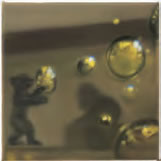 Julia Voss—It was just announced that the Minister of State for Culture and Media, Monika Grütters, has installed the golden bear by Renée Sintenis in her office, as a loan from the Nationalgalerie. The artist created the sculpture in 1956 for the Berlin Film Festival.
Karin Kneffel—I discovered the sculptures of Sintenis on an old photo. They were standing on a Mies van der Rohe shelf in the lady’s salon in the Lange House. Since the shelf in the picture I have from the 1930s was cut off and hence the figures, too, I put a few more in while painting, animal figures by Sintenis, which I had seen at exhibitions.
Julia Voss—Renée Sintenis was a remarkably successful artist at the time. Then she was simply forgotten for a long time. Do you have an explanation for that?
Karin Kneffel—It’s crazy, but it’s always only men who are remembered. Look at this lamp (Karin Kneffel points to a painting from the year 2009). Mies van der Rohe designed it, with a small, round foot. Its lack of stability was roundly criticized by the owners then. For me it’s a faulty design; you see it in the thing. Big shade, little foot, that can’t augur well. Now look at the chair behind it. Lilly Reich made that, his partner. Much of what Lilly Reich made went under the label of Mies van der Rohe. When he went to America, she stayed in Germany and archived, took care of and carried forward everything on his behalf. When she died, her estate was sent to America to Mies van der Rohe. Everything was stored, and only a few years ago did the museological reappraisal begin.
Julia Voss—Lilly Reich died in 1947; Mies van der Rohe, in 1969. Their history is unfortunately typical for how things went in many artist partnerships. What would have become of Kandinsky if Gabriele Mü¨nter had not looked after his legacy? What of Raoul Haussmann without Hannah Höch? Only Hans Arp engaged himself movingly for Sophie Taeuber-Arp, who died long before him; he outlived her by almost twenty years.
Karin Kneffel—The Arps are an exception. To this date the estate of Lilly Reich has not fully been worked through, as far as I know. There is much to be done. How long that has been already now, and how little has changed! For this reason, I painted her chair into my painting, and because it is so idiosyncratic; it did not even stand there at all. But I want her to be remembered.
Julia Voss—Did you grow up in an artistic environment? Did you already know early on that you wanted to be artist?
Karin Kneffel—No, both not. Art was not to be found in our family. The house in which I grew up was one of these pitched-roof houses, a typical Ruhr Valley house; I immortalized something similar in a series of houses.
Julia Voss—In the series from 2013?
Karin Kneffel—Yes, I sometimes drive by it – the house stands on a road to Mü¨lheim an der Ruhr – and I wonder every time I see it how these paintings could have emerged out of that. Trash cans stand in front of it, everything really shabby and triste. But the house is almost a prototype. It appears in ranks in the Ruhr area. When I saw it for the first time while driving by, a threatening tree shadow fell on it, cast by a yellow street lamp, and all of a sudden, a whole array of pleasant as well as unpleasant childhood feelings arrived for me. In a way like when one follows a crack in the wall as a child, the fantasy gets rolling, and one’s own film begins. Coal-dust-black window benches, miners with black eyelid lines, homing pigeons, food kiosks. The old boredom, tristesse and narrowness, which often assailed me as a child, became directly palpable again. I imagined how I would paint it. With shadows and the silhouettes of the tree, to create its own atmosphere. All at once this building was worthy of depiction.
Julia Voss—You painted up nice [tr. note: “schöngemalt,” literally “painted beautifully,” but also with an overtone of euphemistically prettifying something less attractive] the house of your childhood?
Karin Kneffel—Exactly.
Julia Voss—Like Gabriele Mü¨nter. When she lived with Kandinsky in Murnau, they both not only painted the house and the furniture together. On top of that, Mü¨nter also painted the interior design in oil on canvas and hung it on the wall. Painting has this magical power. Does reality become what it is in the picture?
Karin Kneffel—Yes and no. The realism of the picture is a pictorial world that is convincingly effective and yet different from any reality. The painting reveals itself as painting and thereby changes the reality. In each of these houses, the same thing happened; everybody looked at the same film at night. One looked out the window and in doing so had a mirror held up to oneself. What the people across from us were doing, we did, too. Initially there was just the one television program, and when an Edgar Wallace or Hitchcock film, for example, came on in the evening, it ran in every house, and the streets were deserted until the test pattern came.
History
Julia Voss—In the series from the last years, you are occupied with the Esters House and Lange House, two villas in Krefeld that Mies van der Rohe built at the end of the 1920s. What was at the start of your interest in this?
Karin Kneffel—It started when I was invited by Dr. Martin Henschel, who was museum director at the time, to put on an exhibition in the Esters House or Lange House. Both former residences are now museums. I still had Erich Fischl’s exhibition in mind. Fischl had hired two actors, who played a married couple, a married couple with problems. Beforehand he had refurnished the houses. Then he photographed everything, went back to his home country and painted his paintings, which he then showed in one of the villas. I thought that was pretty good and absolutely wanted in my conception of the exhibition to also produce some relationship to the houses. I became occupied with historical photographs from the archive in order to see how the houses looked then, from inside as well. The photographs are all in black-and-white, however.
Julia Voss—When are these photographs from?
Karin Kneffel—They were done at the beginning of the 1930s, on order of Mies van der Rohe, I believe. It was about the architecture, not the art. Then I read somewhere that the curtains were blue. I realized that windows played a huge role for Mies van der Rohe, the transition from inside to outside and the flowing movement in the rooms. My first difficulty consisted in the fact that the black-and-white photographs offered me no clue as to the original colouring of the objects in the rooms, and apart from that I also didn’t want to put in colour arbitrarily. That brought me to the idea with the panes. When I imagine an evening light falling on the panes, then it does not matter whether the original photographs are black-and-white. The imagined lighting creates the colours in the picture. Everything began then with this device.
Julia Voss—When did you begin to reconstruct the collections?
Karin Kneffel—In my first pictures, I painted the paintings on the walls unrecognizably, since for one thing my primary focus was more on the architecture and furnishing at first, and for another there were many paintings and sculptures on the photographs that could be recognized only poorly, if at all. As my interest in the collection became greater, I tried to find out more about it, read the little that I could find about it, spoke with relatives and by means of the internet tried to identify the paintings through the photographs available to me. Kirchner’s Potsdamer Platz, for example, is easily recognized, and so on the internet I researched its current location. Initially I could not immediately identify a Kokoschka, Sommer I. [Summer I]; it took somewhat longer till I could find the painting.
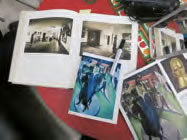
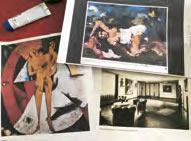
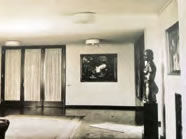
A coincidence during the search for another work played into my hands there. The internet is very helpful, as well, for finding out the fate and current location of a painting. I didn’t want to do academic research, rather just to work with what was easily able to be established. At the end, I superimposed a transparent version of the painting onto the photograph in order to be sure.
Julia Voss—Isn’t it astounding that these researches had not already long since been undertaken by art historians?
Karin Kneffel—There are none that I am aware of, but in all the publications the main attention is given to the architecture of Mies van der Rohe and his relationship to the building owners. Many paintings are of course perhaps no longer in possession of the descendants. For instance, the painting by Kirchner, Potsdamer Platz. At the time that was the Nationalgalerie’s most expensive purchase.
Julia Voss—The painting was acquired in 1999. Were there discoveries during the research?
Karin Kneffel—One of the Chagall paintings, Der Heilige Droschkenkutscher [The Holy Cabman], which hung in the dining room of the Lange House, is found today in Frankfurt in the museum. I drove to the Städel and looked for it there. It just took a bit before I found it, because there the painting was hung the other way around, upside down. That seemed wrong to me and so at first I didn’t immediately recognize it.
Julia Voss—Because Chagall’s “Cabman” then looks as though he would be falling?
Karin Kneffel—Exactly. The Holy Cabman, he just has to fly. That’s how I knew it from the Lange House. But of course, it could also be the case that due to long observation of the photo, the painting had stuck in my mind as the right way around only so, although it might perhaps be otherwise. On the following weekend, I flew to Los Angeles. The Broad Museum was being opened, and I came across Max Hollein – at the time he was still the Director of the Städel Museum. And so quite spontaneously I asked him: Why does the painting by Chagall, The Holy Cabman, hang upside down by you in the museum? Hollein answered me: Both ways of hanging are possible. By us the painting is hanging upside down because we want to know how we like it best.
Julia Voss—Is the painting still hanging like that in the Städel Museum?
Karin Kneffel—Three weeks later I was back in Frankfurt, so I went to the museum again. The painting was hanging at a different location and had been turned, The Holy Cabman flew again, and it still makes me happier that way. The signature is not in an unambiguous place. When he’s flying, the signature is upside down, hence it’s not entirely clear at all how it ought to be hung; both are possible. So I painted it twice, once as it hung initially in the Lange House and once as I saw it during the first visit in the Städel. Next to the sculptures of Picasso and Otto Freundlich.
Julia Voss—The pane through which one sees the scene is fogged over. Through this the space acquires a temporal component for me; it becomes a station on a timeline, transitory and mutable. Is that what it is about for you?
Karin Kneffel—I want spaces and times, past and future to fuse in my paintings. What is reality, what fiction, where does the pictorial reality begin? The gesture on the pane is really one made by anyone in front of a fogged mirror in the bathroom, in order to see more clearly. Usually one just makes everything worse, and at the end one sees less. I liked this effect.
Julia Voss—You have retraced the paths of many paintings, their journey from a private house into public museums. Are there ideal places for your paintings?
Karin Kneffel—I haven’t given that any thought yet. Perhaps the most ideal site would be one that would be built around the pictures post hoc. I can often better remember paintings in private rooms. It does them no harm to be in such a setting. Sometimes I even like it when a sofa is standing nearby. Something happens there. Especially with paintings that show an interior themselves. The paintings can withstand that.
Studio
Julia Voss—How long do you need for a painting?
Karin Kneffel—It is relatively complicated with these see-through views, drops, close-up and distance vision, flat panes and simultaneous depths of space. There is no photo of such a scene. I have to consider the light, the reflections or the condensation. I conceptualize for a long time, also on the computer. Then I draw, test further. The work process lasts a good while in the first run. On some paintings, I work mentally for several months.
Julia Voss—When you have found the form, how long does the implementation take?
Karin Kneffel—When I know exactly how everything should be and the preliminary sketch is there, then on a large painting I paint for about a month.
Julia Voss—How do you proceed; what are the steps?
Karin Kneffel—At the beginning there is the primed canvas. I draw on it with charcoal. Since I usually take a real space as a starting point, which is also supposed to remain recognizable, the preliminary sketch has to be right; then come the objects, too, the paintings and furniture and other interior items. In the process, a lot then still changes because when large, the things function differently than in a small sketch. So, I discard once more, wipe away, draw again, perhaps from a different angle of view. Only then the colour comes.
Julia Voss—How would you describe the evolution of your painting?
Karin Kneffel—It’s becoming ever more difficult, more full of detail, and hence more protracted. I myself am surprised at this. Among painters the path has frequently been the other way around; they seek abstraction, simplification. That is not the case with me. I am becoming naturally more routine and professional; there is a progress in terms of handcraft. Twenty years ago, I could not have painted my paintings today; I would not have known how. A pane in front of a scene, still with traces of water on it, I would not have managed that. And if one cannot do something, one does not arrive at the idea of painting it.
Julia Voss—You have painted not only water, but also fire. Why?
Karin Kneffel—The fascination for fire was a painterly challenge, because I could not imagine how that could work, to freeze the movement of the fire in a quasipainterly way. It could be better to shoot a video of fire, I thought, since it’s from the movement that it lives, flickers and flares. Can I at all paint that? The question excited me. Also, the psychology of fire, the threatening. What about the danger in the painting? I wanted to remove the big fright from the fire and try to present it more as an aesthetic phenomenon. One shouldn’t feel threatened by it. That did not quite succeed; it takes hold of some people who are acquainted with war.
Julia Voss—Do you look at other contemporary painters to see what solutions they have found?
Karin Kneffel—Clearly the work of my colleagues interests me and what they are adding to painting. But everyone seeks their own questions.
Julia Voss—How do you recognize that a painting is finished?
Karin Kneffel—If the gaze doesn’t run up against anything anymore; I paint until nothing disturbs me anymore. If I can no longer make it better, then I stop. Otherwise I have to paint on more or paint over. The painting has to work smoothly, to be from the same mold; I don’t want to see any breaks. It has to surprise me. Then it seduces me.
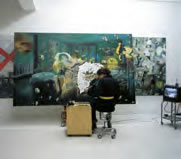 Julia Voss—Do you have a routine in working?
Karin Kneffel—In a certain way, yes. I need my quiet in the mornings. I go jogging or into the woods, do my mail, take care of office tasks, read the paper and breakfast for a long time.
Julia Voss—When do you begin to paint?
Karin Kneffel—Midday. I go down into the studio and paint for five or six hours. Then I get hungry. We cook something fast. Then comes the second shift. That is my most important one, then I have the most quiet, no one calls anymore after dinner. Often, I leave the television on in the background or listen to music. I like it when a picture is still flickering near me in the late evening. Then it is not so lonely.
Julia Voss—You have no assistants. Why not?
Karin Kneffel—I like most being alone in the studio. Even the canvas I still stretch myself; only the priming is taken over by someone for me. The canvas has to have a certain tension, like a drum. When painting I feel that immediately. If somebody else does it differently, I feel it, as though I had taken the wrong brush in the hand. The counterpressure isn’t right. Some colleagues let others paint; personnel stand there on ladders and work together on the paintings. In my kind of painting that is not possible, since I do not have an exact template that others can paint a copy from. In that kind of painting, an outcome has to be exactly fixed almost already from the start and only has to be carried out. But my paintings emerge to a large extent in the painting process and are also changed thereby. A lot is on the examination table, ideas are called into question, even rejected, because maybe they do not hold up or the implementation is beyond me. I try to think further about things and in doing so also put them into question again. No one can help me there, unfortunately, and without this work I would surely be missing something, and certainly my paintings as well.
Colour
Julia Voss—On some paintings, you have painted thick brushstrokes. Would this gestural painting also excite you?
Karin Kneffel—I like very much looking at gestural, impasto painting in others. Only it’s not my thing. My brushstrokes are painted thin with oil paints; it just looks as though the application is impasto. I am sometimes asked why I make the effort when I could also accomplish it with a quick, impasto gesture. Thick paints interest me, but not in my own paintings; at some point there is dust lying on the paint, and they also often shrivel up a bit more. When the materiality of the paint is so much in the foreground, it disenchants the painting for me.
Julia Voss—What happens when you make a mistake in painting? Can you correct that when doing such a thin application?
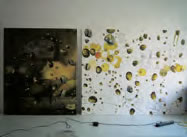

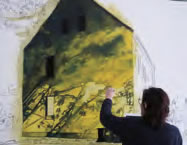
Karin Kneffel—Yes, especially then. Then I can apply several layers on top of each other without there being shrinkage cracks. If, however, I have large, smooth surfaces in front of me, then I have to paint them through in one go. With each painting I think about where I need to start. With the drops or maybe with the room? Do I feel good, or should I rather begin with something easy so that I am not immediately frustrated if I don’t succeed at something? If I have a lot of time, I begin with a surface that I know I have to keep at for a long time. If I were to stop in the middle, then the next morning there is a seam [Naht].
Julia Voss—Is that called a “seam” [Naht] in painting?
Karin Kneffel—No idea, I just call it that. I mean the edge [Kante] that arises during the drying process and remains visible. That is, with large painting surfaces that do not offer me any compositional edges like wall corners or objects in the pictorial space, I have to hold on for a long time and cannot take a long pause. That can go on for fifteen hours at a time.
Julia Voss—But after so many hours there is still a physical limit?
Karin Kneffel—If I really cannot do anymore, I lie down for three hours and set the alarm. For about that long the paint is still wet and has the consistency that I need to keep working without a break. Otherwise in such a beautiful, smooth surface you would see an edge somewhere. That shouldn’t be.
Julia Voss—Your brushes are surprisingly fine. Do you not use thicker ones for the large paintings?
Karin Kneffel—No, actually not. Only very rarely do I use a larger one. With these here I also paint the seven-meter paintings. Even if I were to only stipple the whole painting, I’d still be busy for a while with these little brushes. But it’s only that way that I manage the desired transparency and depth.
Julia Voss—A last question: In your paintings, cleaning crews show up repeatedly. Why?
Karin Kneffel—Cleaning women have a different perspective on things; I like that. They have to ask themselves, where is the dirt, where do I have to clean, where do I have to be careful? As a result, they look at the art differently. The cleaning women in the series on the Esters and Lange Houses are in part citations from films. I wanted to vivify the houses; the figures fit. In the 60s and 70s cleaning women show up more frequently in films, often almost unnoticed and by the bye, since they have no relevance for the plot of the given film, for example, in The Front Page by Billy Wilder; even several times in Hitchcock, among others in Marnie and Torn Curtain, but also in Koster’s Harvey. There is a nice film by Rem Koolhaas about his house in Bordeaux from the point of view of the cleaning woman and other domestic servants.
Julia Voss—In your paintings on the Lehmbruck Museum, window washers also appear. Is that also in Hitchcock?
Karin Kneffel—No, not that I know. For my paintings on the Krefeld Houses, I was repeatedly in the Lehmbruck Museum in order to look at the sculptures. The interior of the museum with the glass cube cast me under its spell over and over again, but for a long time I had no compelling idea until I wondered one day how it would look if there were window washers at work there, and that’s how I populated the architecture in an imaginary way. The movement while wiping, the reaching out, this almost painterly gesture on the panes. Right now, I am painting the third painting of this series. I will keep it for myself. On average I manage about twenty paintings per year. That is not a lot.
(Translation by Ehren Fordyce)
Julia Voss, »Gespräch mit Karin Kneffel in ihrem Atelier in Düsseldorf//Conversation with Karin Kneffel in her Studio in Duesseldorf«, in:Still, Ausst.-Kat.//exhib. cat. hrsg. von // ed. by Kunsthalle Bremen, Museum Frieder Burda, Schirmer und Mosel, S.//pp. 84–94, 2019, ISBN: 978-3-8296-0873-2