Karin Kneffel in conversation with Louise Neri
on occasion of the exhibition Karin Kneffel
gagosian gallery
456 North Camden Drive, Beverly Hills April 28-June 11, 2016
Loise Neri, »Karin Kneffel talks«, in: Gagosian Magazin, summer 2016, New York, S.//pp. 62 - 65
Karin Kneffel On the eve of her first-ever exhibition in Los Angeles, painter Karin Kneffel talks with Louise Neri about her most recent body of work, which concludes a long engagement with Ludwig Mies van der Rohe’s twin housing project for two art collectors in Krefeld, Germany, now the Museum Haus Lange and Haus Esters
In her ongoing inquiry through the medium of painting into the indeterminacy of what we think we see and know, Kneffel considers taste-making and how art lives in the world. This is an artist’s story in pictures about a collector’s house and the art that filled it; the transformation of a private home into a public art museum; and finally, the process of tracking down and imaginatively reuniting, in paint on canvas, key artworks that once hung in the house, | now dispersed in museum collections throughout Europe.
Louise Neri How does your latest body of work relate to all that preceded it, including your exhibition at Gagosian New York in 2012 and subsequent exhibitions in Europe?
Karin Kneffel The first painting in this new series is a crossroads where my obsession with Alfred Hitchcock ends and the search for Hermann Lange's artworks begins. The situation in this first painting generated all subsequent paintings, because of my decision to look for all the artworks that once lived in the Haus Lange.
LN So you are still working on the memory of this house?
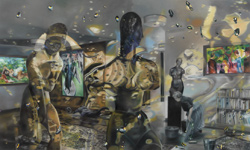
KK Yes. When I began working with Haus Lange as a subject, the artworks were always there, in the house, but I was so focused on the architecture that I did not really see them. Or rather, I was looking at them without being engaged in what they actually were. It is an interesting thought, to look at one thing and in doing so, overlook the details of another. I'm a painter but I didn’t initially recognize all these famous paintings. When I started to notice what was hanging in the house, I thought, “My God, but that looks like a Kirchner or a Macke!
” 
LN So you were seeing them in terms of decor in a scene, rather than as autonomous artworks?
KK Exactly. I was looking and not sure of what I was seeing, partly because the reference material that I was using was so poor.
LN Black-and-white photographs?
KK Yes, and very small. I wanted to find out more, so I started looking at the Internet and trying to track everything down through it. I viewed the found archival photographs in Photoshop to give greater transparency, and that helped me to identify each of the artworks. Sometimes it was pure guesswork. I wanted to find the works by myself, one by one, and see where that led me.
LN Why did you insist on visiting the historical artworks once you had tracked them down?
KK I wanted to experience them in the flesh after seeing them only in black-and-white reproductions and on the Internet or in books. For example, Marc Chagall’s Homage io Apollinaire [1911-12] is painted with metallic gold and silver. You could never perceive this in a reproduction. So I bought the same paint and used it to render his painting in my own composition.
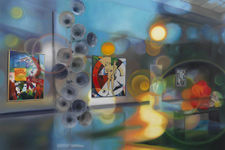 I went to the Van Abbemuseum in Eindhoven three times to see this Chagall. I also visited Ernst Ludwig Kirchner’s Potsdamer Platz [1914] several times, once at the Kunsthalle Würth, where it was on temporary view, and the Alte Nationalgalerie in Berlin, where it lives permanently. I also came to realize that, in some museums, the same relationships between artworks were being recreated, over and over again.
LN Are the museum galleries that are depicted in your paintings real places?
KK Yes, for example, one painting shows the Alte Nationalgalerie in Berlin. But even if viewers recognize the room, they don’t remember the actual layout of the works in last year's exhibition Impressionismus-Expressionismus.
LN So your work also deals with the deception between memory and reality. When you your- self went to the same museum on different oecasions, the installation had been changed, so it was the same but different. This is where your new work comes together with the earlier work on Hitchcock, where you play on the difference between consecutive film frames. In a film, this lapse of time can be a matter of seconds, but in the museum, the change may be over months or years.
KK I paint temporalities that are sometimes factual and sometimes imagined, or sometimes about the slip in our own imaginings of what was or was not there, or how it appeared. For example, where I discovered that Chagall’s The Holy Cabman [1911] was actually installed upside-down at the Schirn Kunsthalle in Frankfurt—or the switching of two morph- ically similar sculptures, Picasso’s Head of a Woman [1931] and Freundlich’s Ascension [1929], at the Städel Museum in Frankfurt.
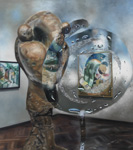
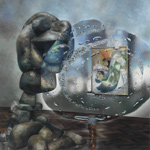
LN Your depiction of these historical works reveals the twists and turns in your search for them. It involves you moving between the received images of the artworks and the real artworks as you encountered them. Just as with the influence of Hitchcock, one becomes aware that you are always negotiating between mediatized images—of film, of artworks on the Internet—and the real artwork, but in relation to your own painting, which is the most artificial surface of all.
KK Yes, exactly. But then, in the case of the sculptor Wilhelm Lehmbruck, I couldn't determine from the historical documentation exactly which materials he used in his sculptures. As he used many different ones, I decided to take artistic license and choose whichever material would make the best painting for myself.
LN Has your approach to using color changed?
KK I paint with color for impact not substance. I never like color or paint as material, only as a vehicle of the imagination, very flat and sheer. I really like to paint, but I don’t want the effort and volume to be evident. I don't need it. It's purely at the service of the imagination.
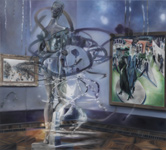
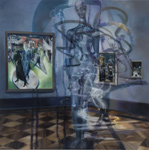
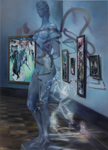
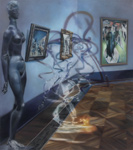
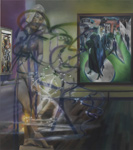
LN In the previous series of paintings from 2012-15, you painted reflections and drops of water and condensation as screens through which to view scenes. In the new works, these devices have all but disappeared and now you are dealing in different and very complex mixing of atmospheres, which are not as consciously separated as before. More than ever, these paintings seem to be emanations of the imagination, possessing a strongly oneiric quality. The overlaid graffitis and light plays are much more complex, like unearthiy frequencies playing over the surface rather than delinquent human interventions designed to disrupt the picture plane
. 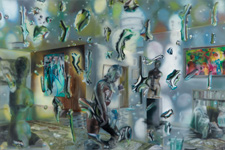
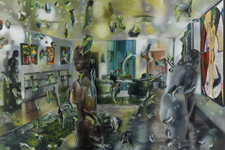
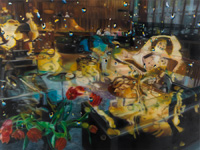
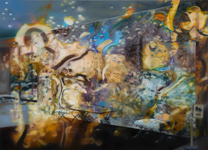
KK The newly complex reflections make the paintings more abstract. I “find” these forms as l am painting, in a kind of process of reverie that sometimes borders on the ecstatic.
Loise Neri and Karin Kneffel 2016
Loise Neri, »Karin Kneffel talks«, in: Gagosian Magazin, summer 2016, New York, S.//pp. 62 - 65