Marion Poschmann
on occasion of the exhibition Karin Kneffel
STILL
Kunsthalle Bremen, Museum Frieder Burda, Baden-Baden
Marion Poschmann, »Schlafende Hunde//Sleeping Dogs«, in:Still, Ausst.-Kat.//exhib. cat. hrsg. von // ed. by Kunsthalle Bremen, Museum Frieder Burda, Schirmer und Mosel, S.//pp. 28–33, 2019, ISBN: 978-3-8296-0873-2
Sleeping Dogs
Dogs
They lie on a glossy surface, seeming to float. They are reflections of an unseen original above, slightly distorted, as if smudged. They lie on a shimmering surface, in a two-dimensional stream: They themselves shimmer and flow a little; even if they seem motionless, they are not fixed. They lie next to a blurry piece of furniture or a flying carpet, and one never knows where they are actually situated — above, or below? In the air? In the water? Do they pretend, lying there casually, that there is a floor there, a reliable ground — even a carpet, or parquet? The dogs sleep, and even when they are awake, standing and smelling, their heads raised attentively, even when they run with flying ears, they are asleep, so to speak. A dream dreamed principally by dogs: sniffing and hunting, following tracks, the wind running through their fur, the trembling and panting, the baring of teeth, the twitching paws ready to pounce even though the animal, seen in reality, lies rolled up in the basket. As the saying goes, let sleeping dogs lie.
Sleep
Dogs process the experiences of the day in their sleep, just like humans. The perceptions of the waking consciousness find a new order in the dream; memory constitutes itself, learned things are stored, knowledge is solidified. Dogs too often disturbed while sleeping seem dumber — they are worse at completing tasks and exhibit impaired memory and poor concentration when being trained.
Anyone waking a dog is violating its territory, even if that territory is the domain of sleep. It should not be surprising, then, if the dog defends itself, attempts to protect its territory, growls and yelps, barks and rages, bares its teeth, threatens with its ears, pulls its lips back ever further and finally bites. A dog torn out of its sleep may even snap at its own careless owners. Internalized behavior, reflexes? Perhaps the dog had just been dreaming of roaming the woods with his master — now comes someone else posing as his master, and how is the dog supposed to know who is real, and who is not? A dog’s dreams produce doppelgänger.
Reflections
A dog is walking on a reflective surface. Behind him, there’s another one. They look very similar — their stature, the colour of their coats, and the markings can hardly be distinguished. Are there in fact two dogs, or is it just one dog depicted in two different phases of movement? Are they, strictly speaking, dogs at all? One sees them running, but they’re on their heads; they run along the upper edge of the picture upside down, reflections of one — or two — originals that one must imagine as cause and reason, an absent basis, an omission that must be filled in by the viewer in order to understand the result.
A Dalmatian is lying down inside. He positions himself to sleep, his muzzle embedded between his front legs, but he is not sleeping; his eyes are open. Something’s not right about this dog. He’s lying on a vividly reflective surface, as if on water or very smooth ice. The head in the reflection is raised and looking around. The reflected image is not of another dog but of another moment, further forward in time, or backwards, a reminiscence, a ghostly apparition? Is it reason that is sleeping here? Is irrationality dreaming a dream of wakefulness, of surveillance, of enlightenment?
Gatekeeper
He is lying on the threshold. Between up and down, past and future. Between the familiar and the strange, between here and there. The dog is guarding home, property, possessions; he guards the familiar and sets it apart from everything else, from what is alien and unfamiliar. The dog guards the threshold to what is uncanny, and he embodies this threshold all the more when he is sleeping.
In antique mythology, the dog Cerberus guards the entrance to the Underworld. He is usually depicted as a beast with several heads looking in different directions — usually three heads, sometimes a hundred, sometimes only two. Cerberus ensures that no living person gets into the Underworld and no deceased person gets out. Anyone wishing to pass this dog illicitly must pacify him. Orpheus did this with music; the Cumaean Sibyl who accompanied Aeneas used a sleeping pill:
Huge Cerberus, crouching there in the dooryard of
The cavern he was watchdog of, made all
The regions round reverberate with the loud
Barking of his three heads. Seeing the serpents
Bristling around his neck, the Sybil throws him
A drugged pellet of meal, drowsed with honey.
He catches it in his ravenous triple gullet,
Wolfs it down, and at once his monster body
Relaxed, and he sank down, and lay stretched out
Across the mouth of the cavern that he guarded.
The watchdog lying there asleep, Aeneas
Gets in through the entrance to the cavern,
And leaves behind him the bank of the river that
No one comes back from ever.
(Virgil, The Aeneid, Book VI. Translation by David Ferry)
A leopard skin lies next to the bed. The head of the leopard, along with his glassy gaze, is directed at the viewer. On the other side of the bed, the TV is on, showing a huntress with her rifle. They are occupying different spaces; they can no longer come together because, between them, somewhat elevated on a chair, a harmless looking dog is standing and keeping a vigilant eye on the dead leopard.
The passage to the Underworld, the core of the hero’s journey, requires first and foremost the confrontation with the dog. Only when Cerberus sleeps, the myth tells us, is it possible to pass unnoticed from one side to the other.
Anesthesia
What can be used to pacify watchful dogs in pictures? The rooms in which the dogs dwell are unsettlingly empty; they are lifeless. Somewhere, the coat of a cat of prey is hanging or lying; somewhere, a bulky armchair is blocking the way, upholstered with shrill floral patterns in garish colours that contrast with the smoothly polished floor. The deathly silence is suggestive, making one even less at ease, as if one could at most whisper in such a deserted room. The dog is lying there with the television on, but no one seems to be there to watch it. The dog is dozing, but his reflection is alert, looking upwards, looking at us, the viewers. The television, too, seems to be on for no one but us. It is placed so that we are the only possible watchers. This results in a queasy feeling, the mild fright created by a psychological thriller: We are not seeing the image Fig. p. 75 Fig. p. 185 Fig. p. 183 (Virgil, The Aeneid, Book VI. Translation by David Ferry) Fig. p. 22 Fig. p. 26 from the outside but rather observing the space from within — we have been painted in. To avoid conjuring any evil, to avoid scaring the dog, one must walk on tiptoes, sneaking slyly and quietly by, withdrawing so far that one blends in with the space, withdrawing from oneself.
Underworld
The river Styx, the “water of horror,” constitutes the boundary to the Underworld. Again and again, 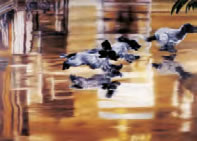 attempts have been made to locate the entrance to the mythological Underworld, but there are many bodies of water, and, as we know despite all legends to the contrary, no one alive has entered the realm of the dead. In Karen Kneffel’s paintings, however, this entrance seems to be everywhere. Harmless interiors, owing to their smoothly polished floors, become raging Underworld rivers. Glass windows divide the pictorial space into this world and the hereafter. Condensation is often running down these windows, rainwater or cleaning water, a vertical river, the quotidian Styx that runs over shop windows, displays, and vitrines. On the foggy panes, warning signals are drawn over and over, large St. Andrew’s crosses, lines that say: This far, but no further. The impression of a flat hand, the defensive gesture demanding that one stop. They are the typical pictograms of traffic signs, only hastily made, as if they were incidental, secret signals, perhaps for someone capable of decoding them, for the passerby rushing there with equal haste. Some window panes show a rudimentary shape: a smiley face, grinning, or also with the corners of its mouth turned downwards, a large face with an accentuated mouth — a caricature of the hellhound who steps forward in warning?
The way is blocked, but the gaze can glean something of what lies behind the glass. Moviegoers, for example, staring at a screen, but instead of a film one sees only the damp wall of glass upon which someone’s finger has written: The End. One sees the writing from behind, backwards. We, the observers, are located at about the spot where the characters in the film would be moving. This world, the world beyond; here the living, there the dead: The deeply uncanny thing about these compositions is that we, the viewers, never know exactly which side we are on.
Realm of Shadows
To rouse the dead back to life, or at least to capture their image, to show them as if they were still in our midst: This original mission of painting, perhaps its most noble one, effectuated early on, for example, in Egyptian portraits of mummies, is always present in the paintings of Karin Kneffel. With that in mind, what kind of cult of memory do her portraits of animals, in which the heads of farm animals, cows, sheep, and chickens are documented, even preserve? Is the individuality of some unknown rooster being thought of here, and what is the point of our knowing what it looked like?
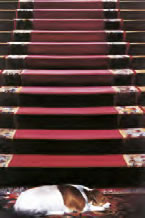
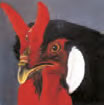 When the dogs sleep, the boundaries become porous. The differences between the living and the dead become blurred; identities become uncertain, shadows become interchangeable with bodies, images of images emerge, strange mixtures of what is allegedly real and illusion. Doors and steps scale a room, as if Hades awaited just beyond. Partially drawn curtains divide a window in halves, into fabric patterns and plant ornaments, into nature and culture, divide the view into inside and outside, but the observer partakes in both. In forbidding paradises, apples, cherries, grapes, plums, and peaches grow, terrifically large, terrifically beautiful. They could be made of plastic—they look artificial, in any case. Like the fruits of Tantalus, they seduce with their ostensible sweetness; they rise up threateningly, like the Archangel Michael with his flaming sword, and the viewers grow flustered as they find themselves simultaneously within and outside the Garden of Eden.
Painted museum visitors and painted statues, painted film actors and painted paintings remain recognizably located in separate pictorial levels, but the figures of life and the figurations of art nevertheless join together in a bewildering roundelay — shadows of shadows, perhaps a dance of death?
Water
Water is often the medium for crossing from one domain into another. The fruits are misted, the window panes wet, the curtains hung in waves; a carpet looks like a water lily pond, and a bed covered with a quilt is as black as the sea.
Cleaning ladies kneel beside buckets as they prepare to cover entire rooms with their water, transposing them into something uncanny with a move of their rags, brushes, and brooms, as if they were painting — superficially, they seem to be powerless creatures, but on the soaped, slippery floor, other people can easily fall. Perhaps Karin Kneffel is also paying homage to this precipitous power of water in her explicit water paintings.
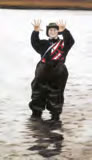
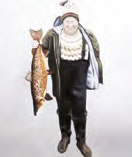
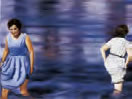
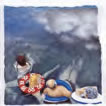 In the watercolours, people stand in water up to their knees and present a fish. People have rolled up their trouser legs, gathered up their skirts and waded through knee-deep water into an indeterminate darkness. A fisherman in full gear lies, sits, and half-squats in gray, turbulent waters. People bathe— you can see them from above — their bodies still protruding halfway out of the water, held afloat by a colourful life preserver; the other half, submerged, is where the extremities blur, seeming to dissolve from the feet upwards. The life preserver, which looks downright silly on adults, marks the water’s surface, where the refraction of light begins: It shows the beginning of the depths upon which everything is reflected.
These bodies, whose extremities extend beyond what the eye can see, make one strangely apprehensive. This invisible bottom conceals the transformative power of water; here, the gaze shifts; here, time goes by and snatches everything familiar with it, altering what was thought to be unalterable. Panta rhei, Heraclitus says: Everything flows, one doesn’t enter the same river twice. The water is constantly changing, and the individual also changes when crossing a body of water — because time passes.
In Ovid’s Metamorphoses, Scylla is enchanted by Circe as she goes into the sea a bit, up to her hip. Her belly transforms into slobbering dogs, into the mouths of Cerberus. She is seized by the monster — she herself becomes a monster:
There Scylla came; she waded into the water,
Waist-deep, and suddenly saw her loins disfigured
With barking monsters, and at first she could not
Believe that these were parts of her own body.
She tried to drive them off, the barking creatures,
And flees in panic, but what she runs away from
She still takes with her; feeling for her thighs,
Her legs, her feet, she finds, in all these parts,
The heads of dogs, jaws gaping wide, and hellish.
She stands on dogs gone mad, and loins and belly
Are circled by those monstrous forms.
(Ovid, Metamorphoses, Book Fourteen. Translation by Rolfe Humphries.)
Fire
Karin Kneffel’s pictures are full of sleeping dogs. When they sleep or pretend to sleep, they allow the viewer to take a look into the abyss of time. In these paintings, we may take a look at the world of shadows. We see remote figures, shadows of shadows. We see motifs of vanity: the burning and dying candle, luxuriant still lifes of tulips, dead fish, and recurrent optical illusions, stagings of the baroque theater of the world with interlocking stages, Velázquez and Hitchcock, painting and film, the movement of the gaze and the movement of images, the movement of things.
But similarly, we look at the world of the living as if from afar, as if through a clouded window, as if we, like the protagonist in the film The Sixth Sense, were already on the side of the shadows without knowing it ourselves.
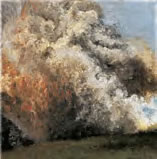 Beside the flowing world, or rather in subliminal rather than spatial relation to it, the fire of the Logos stands as a principle of permanence in Heraclitus. Beyond speech, beyond form, it defies perception, and perhaps it is precisely that which
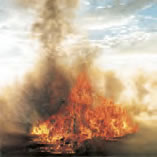 represents the actual object of investigation in Karin Kneffel’s paintings, which nearly overflow with that which is perceptible, juxtaposing layers of visibility against and above one another. The realism accentuated in the images, the extreme rationality that is expressed in them, is not aimed at comprehensibility; instead, the epistemological interest is directed at the uncanny irrationality of the world, the hidden side of things, the imaginary basis of phenomena.
This is demonstrated with particular beauty and apparent simplicity in the fire paintings: The invisible takes form, the erratic flickering is removed from the speed of the moment, and, ever so briefly, we see our own consciousness in the flaming breath of Cerberus.
(Translation by Daniel Mufson)
Marion Poschmann, »Schlafende Hunde//Sleeping Dogs«, in:Still, Ausst.-Kat.//exhib. cat. hrsg. von // ed. by Kunsthalle Bremen, Museum Frieder Burda, Schirmer und Mosel, S.//pp. 28–33, 2019, ISBN: 978-3-8296-0873-2